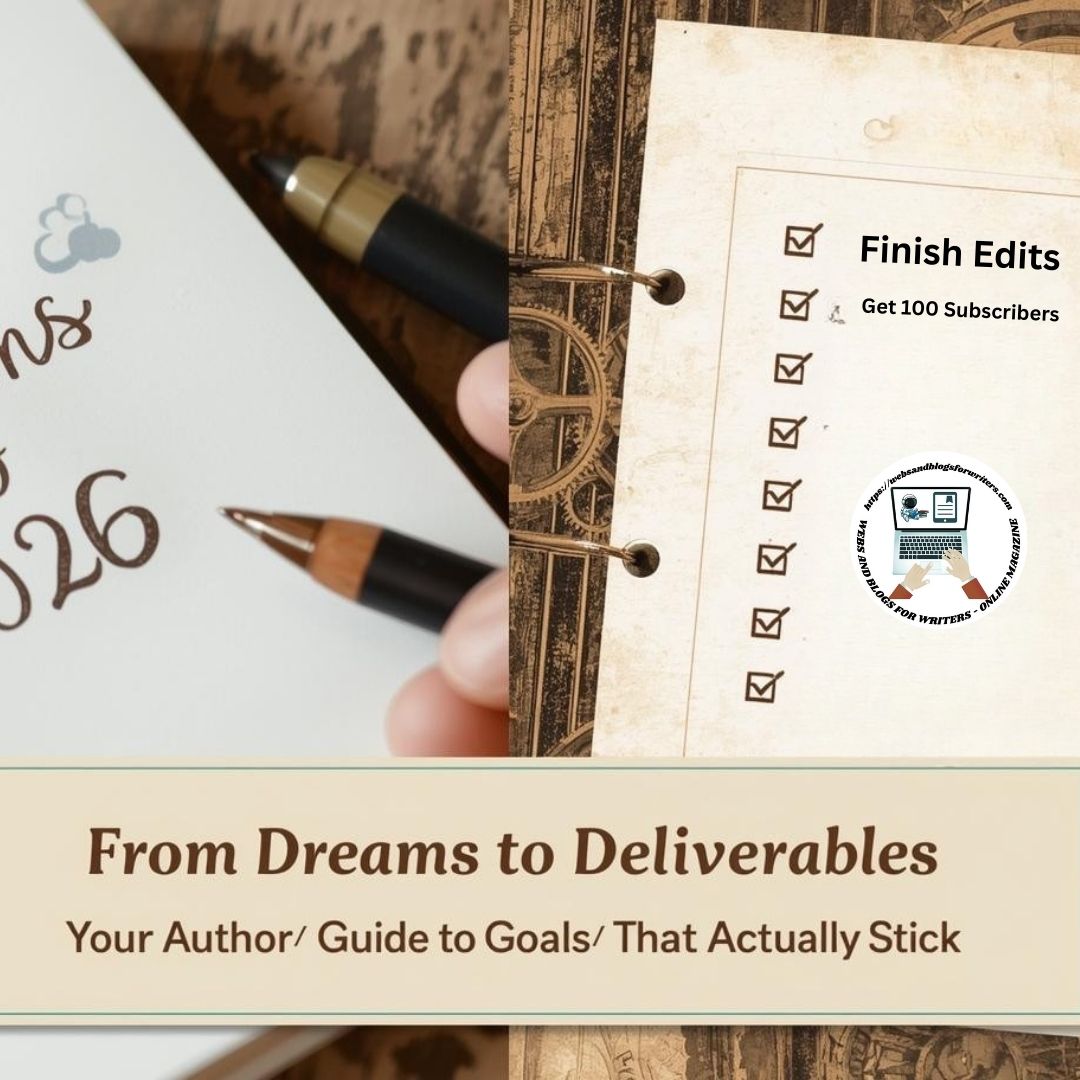
I just wrapped up an incredible webinar with Sisters In Crime about goals and dreams for 2026, and during our breakout session, something clicked for me. As I listened to fellow authors share their ambitious plans, I realized we all face the same challenge – turning those exciting “someday” dreams into concrete, achievable goals that move us forward.
Here’s what I learned from that session, combined with my 30+ years in digital marketing and my ongoing journey as both a fiction and non-fiction author. If you’re juggling multiple projects like I am – from my steampunk mystery series to building my author platform – these strategies will help us both create goals that stick.
Section 1: The Dream-to-Goal Translation Process
During our breakout session, each of us examined our dreams and asked a simple but powerful question – which of these can become actual, workable goals? Here’s the framework I developed from that exercise.
A dream is beautiful and inspiring. “I want to be a successful author” is a dream. But a goal needs specificity, measurability, and a timeline. When I transformed my dreams into goals at the webinar, I focused on five key areas. Let me share them with you because they represent the exact formula that will help me manage Southern Dragon Publishing Services, complete my Master’s program at UF, and continue writing fiction under my L.J. Green pen name.
My 2026 Goals from the Sisters In Crime Webinar:
- Gain 100 newsletter followers on Substack in 90 days
- Convert at least 10 of those followers into paying subscribers within the same timeframe
- Post consistently across all platforms by actually using the tools I already pay for, like Metricool for 6 months
- Build the Solo Sojourn following to 500 social media followers across all platforms with active engagement in three months
- Complete at least three major projects within six months
Notice the pattern? Each goal includes a number and a deadline. That’s not by accident. When you attach metrics and timelines to your dreams, you create accountability. You can track progress, adjust strategies, and most importantly, know when you’ve actually succeeded.
How to Apply This to Your Own Goals:
Start with your biggest dream for 2026. Write it down. Now ask yourself these questions:
- What specific number would represent success? (100 followers? 5 book reviews? 10,000 words written?)
- By when do you want to achieve this? (90 days? 6 months? By December 31?)
- What would be the intermediate milestones? (25 followers per month? 1 review per week? 500 words per day?)
Transform vague wishes like “I want more readers” into specific targets like “I will gain 50 engaged email subscribers by March 31 by offering a free short story and promoting it through my existing social media channels.”

Section 2: The Tools-You-Already-Have Strategy
Here’s a confession that made me laugh during the webinar – I listed “be more consistent with my posting on all my platforms by taking advantage of the tools I already pay for such as Metricool” as one of my major goals. Sound familiar?
How many of you subscribe to Canva Pro, pay for email marketing platforms, or have social media scheduling tools sitting mostly unused in your digital toolbox? I’m raising both hands here. We authors are excellent at collecting resources, but we need to get better at actually using them consistently.
The biggest revelation from the Sisters In Crime session was this – we don’t always need new tools or strategies. Often, we just need to use what we’ve already invested in more effectively.
My Three-Step Tool Optimization Plan:
Step One – Audit Your Current Subscriptions: I sat down after the webinar and listed every digital tool I currently pay for. Metricool for social media scheduling, Substack for newsletters, Canva for graphics, WordPress hosting for my websites, and several author-specific platforms. Then I honestly assessed which ones I use regularly versus which ones I’m essentially wasting money on.
Step Two – Create Tool-Specific Goals: Instead of letting Metricool sit idle, my goal is to schedule at least one week of content in advance every Sunday. That’s specific, measurable, and eliminates the daily scramble of “what should I post today?”
Step Three – Set Usage Reminders: I added recurring calendar appointments. “Schedule Metricool Content” appears every Sunday at 2 PM. “Write Substack Newsletter” shows up every Wednesday morning. These aren’t optional – they’re appointments with my business growth.
Action Items for You:
Take 30 minutes this week to inventory your current tools and subscriptions. For each one, answer these questions:
- Am I using this tool at least weekly?
- Does this tool directly support one of my 2026 goals?
- If I canceled this tomorrow, would I miss it?
If you answered “no” to the first two questions, either commit to using it consistently or cancel it and redirect those funds. I learned this lesson the hard way with multiple subscriptions I maintained “just in case” instead of tools I actually used strategically.
The goal isn’t to have every tool available to authors. The goal is to master the tools that move your specific goals forward. When I committed to using Metricool consistently, my social media engagement should improve because I stopped posting randomly and started creating content strategically in batches.

Section 3: The Project Completion Priority System
“Finish at least three projects within the next six months” was another goal I set during the webinar, and honestly, it felt overwhelming when I wrote it down. I’m currently working on my comprehensive author marketing book “Build Your Author Brand,” developing my Solo Sojourn Trail mobile app using Firebase Studio, managing the Sunshine State Book Festival publicity, maintaining my graduate coursework, and somehow finding time to write fiction.
Sound familiar? Most authors I know aren’t suffering from a lack of projects – we’re drowning in them. The challenge isn’t starting new creative endeavors. The challenge is finishing the ones we’ve already begun.
During our breakout session discussion, one author shared something that changed my perspective – “We need to give ourselves permission to prioritize some projects and put others on pause.” That simple statement was liberating. You don’t have to finish everything simultaneously. You just need a system for determining what gets your energy right now.
The Priority Matrix I Developed:
I took my project list and ran each one through four criteria:
- Does this project have an external deadline? (Like the Sunshine State Book Festival commitment – yes, it has a firm January date)
- Will completing this project generate income or opportunities? (My author marketing book will serve clients and potentially create passive income)
- Am I genuinely excited about this project right now? (The Solo Sojourn app fires me up every time I open Firebase Studio)
- What’s the current completion percentage? (Some projects are 80% done and just need that final push)
Using these criteria, I can identify my three priority projects for the next six months. My author marketing book comes first because it’s nearly complete, will serve my consulting clients and will help me give the paid talk at the Writers Workshop the day before the Sunshine State Book Festival. The Solo Sojourn app ranked second because the Kickstarter campaign timeline matters and I am facing a summer deadline to have followers. The Sunshine State Book Festival landed third, but just as important, because it has that non-negotiable January deadline.
Everything else? Still valuable, still part of my long-term vision, but officially on the “active pause” list until I complete these three.
Your Project Completion Strategy:
List every current project competing for your attention. Be brutally honest. Include that novel you started in 2022, the website redesign you keep postponing, the podcast you mentioned launching, and the social media strategy you began implementing last spring.
Now run each project through the four criteria I listed above. Assign points – one point for each “yes” answer, bonus points for projects over 70% complete. Your top three scores become your priority projects for the next six months.
Here’s the crucial part – communicate your priorities to yourself and others. I literally posted my three priority projects on a sticky note attached to my refrigerator. When I’m tempted to start something new or split my focus, I look at that note and ask, “Will this help me complete one of these three projects?” If the answer is no, I add it to a “Future Projects” list and return my attention to current priorities.
The Solo Sojourn Project taught me this lesson powerfully. I was spreading myself across app development, website creation, content creation for three different platforms, and trying to plan the Kickstarter campaign simultaneously. When I focused specifically on completing the core app functionality first, then the website, then the content strategy, I made more progress in six weeks than I’d made in the previous six months of scattered effort.
Breaking Large Projects into Weekly Wins
Each of my three priority projects now has weekly milestones. For the author marketing book, that meant designating specific chapters to complete each week. For the Solo Sojourn app, it meant finishing one feature component per week. For the festival publicity, it meant completing one promotional task daily for the next two weeks.
These targets are small enough to feel achievable but significant enough that six months from now, I’ll have three completed projects instead of ten partially finished ones.
This approach has eliminated my guilt about the projects I’m not working on right now. Those ideas haven’t disappeared – they’re safely documented in my “Future Projects” file, ready for attention once I’ve completed my current priorities. That mental shift from “I’m failing at all these projects” to “I’m successfully focusing on my top three priorities” changes everything.
A Note from our Editor
We would encourage any North Florida Writers who would like to Guest Post on this site or be a featured author on the North Florida Writers Tour website then please get in touch using our CONTACT US form. Our site has an excellent monthly Newsletter that contains exclusive content. Join in on the fun! CLICK HERE!
If you found our article helpful, we hope you will consider contributing to our coffee fund to keep us up and running creating more helpful blogs now and in the future!

You must be logged in to post a comment.