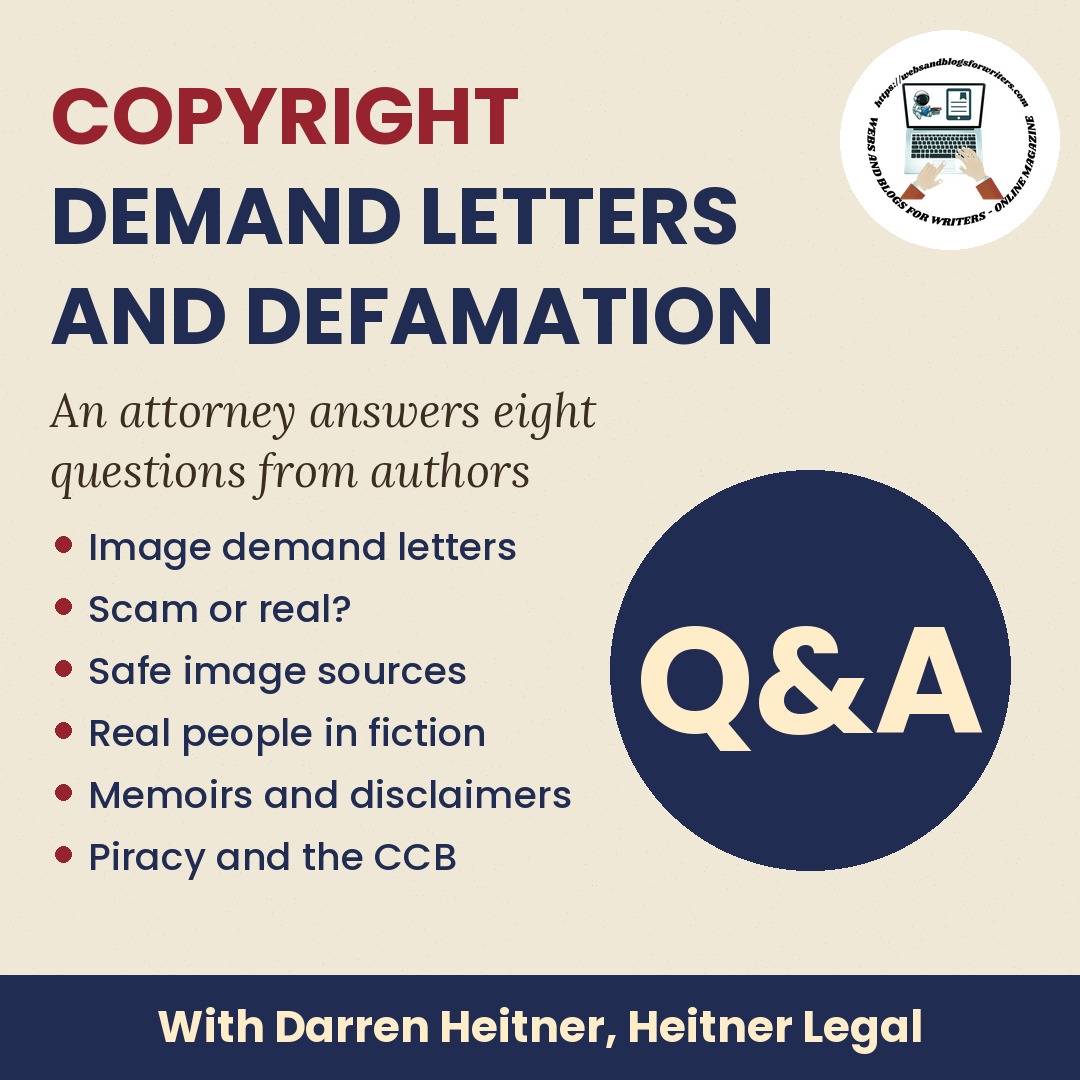
What to do when a copyright demand letter lands in your inbox, and how to keep a real person from seeing themselves in your villain

Two legal worries come up again and again when I talk with authors. The first is a scary letter demanding money over an image on a blog or a book promo post. The second is whether a character based on a real person could land them in court.
So I asked an expert. Darren Heitner is the founder and managing attorney of Heitner Legal in Florida, and he deals with copyright demand letters and defamation for creative people. He kindly answered eight questions authors ask me. Here are his answers, in his own words.
This Q&A is general information, not legal advice for your situation. If you receive a demand letter or are worried about something in your manuscript, talk with an attorney.
Copyright Demand Letters and Images
1. An author gets a copyright demand letter over an image on their blog or a book promo post. What should they do first, and what should they never do?
First, take the image down, save a copy of the letter and the post as it appeared, and calendar any deadline in the letter. Then find out where the image came from and whether you had a license. Never ignore the letter, never pay the first number demanded without checking whether the claimant owns the image and has registered it, and never make admissions in a heated reply.
2. Are these letters ever scams? How can an author tell a real claim from a fake one?
Most letters from PicRights, Copytrack, and similar companies are real, but real does not mean the claim is strong or the demand is fair. Check the sender independently instead of clicking anything, search the U.S. Copyright Office’s public records to see whether the image is registered, and ask in writing for proof of ownership before you negotiate.
3. What’s the safest way for authors to use images: stock sites, Creative Commons, AI-generated images?
The safest choice is a paid license from a reputable stock site. Keep the license receipt and read what uses it allows, since many licenses exclude book covers or merchandise. Creative Commons works only if you follow the exact license terms, including attribution and any restriction on commercial use. AI-generated images are less likely to draw a demand letter.
4. When is it worth calling an attorney instead of handling a demand letter on your own?
Call an attorney when the image is registered, the demand runs into the thousands, or a lawsuit has been threatened or filed.
Real People, Memoirs, and Defamation
5. Novelists often base characters on real people. Where does that cross the line into defamation?
The line is crossed when a reasonable reader would recognize the real person in the character and would take a false, damaging statement about that character as a factual claim about the real person. The safest course is to change enough identifying details that the character cannot fairly be traced to the real person, especially when the character commits crimes, misconduct, or sexual wrongdoing.
6. What should memoir writers do to protect themselves before they publish?
Stick to what you can prove, and keep the journals, emails, texts, and records behind each important claim. Make clear what is your opinion or your memory and what you present as fact, think hard about including private details that serve no purpose in the story, and change names and identifying details of minor characters. If the book makes serious accusations about real, identifiable people, have an attorney review the manuscript before publication.
7. Does a disclaimer like “any resemblance to real persons is coincidental” actually protect an author?
Not much. A court looks at the work as a whole, and a boilerplate disclaimer will not save a book in which the character is obviously a real person. In some cases it can even look disingenuous. Treat the disclaimer as a courtesy, not a shield.
When Someone Copies Your Book
8. If someone copies or pirates an author’s book, what are their options, including the Copyright Claims Board for smaller disputes?
The quickest step is usually a DMCA takedown notice to the platform, marketplace, or host carrying the pirated copy, and most respond quickly. For money damages, the Copyright Claims Board is a less expensive option run by the Copyright Office for claims up to $30,000, with no requirement to appear in court, though the other side can opt out. For larger or repeated infringement, federal court is available, but you need a registration before you can sue, and timely registration is what opens the door to statutory damages and attorney’s fees.
About Darren Heitner
Darren Heitner is the founder and managing attorney of Heitner Legal, P.L.L.C. He is an adjunct professor at the University of Miami School of Law, the author of How to Play the Game (ABA), and a Florida Supreme Court qualified arbitrator.
Website: HeitnerLegal.com
Thank you, Darren, for taking the time to answer these for our readers.
Over to you: Have you ever received a demand letter over an image, or worried about a real person recognizing themselves in your book? Tell us in the comments.
Till next time…
Jolene
A Note from our Editor
Published authors, if you would like to be featured in one of our blog posts, please CLICK HERE. Writers who would like to share a guest article can find our guidelines HERE. We encourage North Florida writers to request a featured post on the North Florida Writers Tour website.
If you have any questions about our online magazine, you are welcome to fill out our CONTACT US form. Our site has an excellent monthly newsletter that contains exclusive content. Join in on the fun! CLICK HERE!
For those who need help with publishing and marketing, check out Jolene’s other website: Southern Dragon Publishing!